Top Neurologist Warns: The #1 Cause of Memory Loss Is Sitting In Your Bedroom (and the Simple Overnight Fix)
"We're beginning to see this strange protein show up in a healthy brain after just one sleepless night. Now, what if someone hasn't slept well in years…?" According to a Harvard neurologist with 22 years of experience, there's a concerning surge in adults with memory lapses. He says fixing this one thing in your bedroom may solve the problem.


Let me tell you about one discovery that changed how I practice medicine.
In just one night, you could wake up with a clear head again. This means, remembering phone numbers, where you parked, words that used to slip away.
I'm talking about the kind of deep, restorative sleep that gives you back the sharp, quick-witted version of yourself your family remembers. It's not magic.
It's a breakthrough positioning ritual I've now tested with my own patients. And it has to do with a special protein that your brain needs to clear out every day.
Now, If you're ready to wake up with the clearest head in years, pay close attention.

"The sticky notes aren't for remembering," Carol told me. "They're for reassurance."
But first, I need you to understand what's really happening inside your brain while you sleep.
Here's the brutal truth:
Your current pillow may be pinching off your Brain Sewer, one night at a time.
Let me explain.
I know because I'm a neurologist who has spent 22 years scanning and analyzing thousands of brain images, yet mostly find nothing alarming, and tell them to "get at least 7-8 hours of good sleep."
That's when a 58-year-old school librarian named Carol came to my office and shattered everything I'd learned over all those years.
Every morning started with a head that felt packed in cotton wool.
The novels she loved reading since her 30s became difficult to read and enjoy again. She would read the same paragraph three times and retain none of it.
Other times, Carol would walk into the kitchen and stand there, waiting for the reason to come back.
The worst part? As a doctor, I saw that her brain looked healthy, and all I could tell her was to "try to get better sleep."
For Two Years, She Did Everything "Right" — And Nothing Changed

Carol's bedside table, two years in. Everything a worried person is told to try.
She'd tried everything I could possibly recommend to improve her cognitive health.
Crosswords that kept her busy but not sharp.
A brain-training app that gave her a daily streak and nothing else.
Omega-3 capsules that did more for her wallet than her memory.
Nothing worked long-term.
So she tried to sleep better, too…
- Over-the-counter sleep aids: They knocked her out, and she woke up foggier. That's no mystery to me — the Mayo Clinic and the National Institute on Aging both warn that the antihistamines in most "PM" pills cause next-day grogginess and carry extra risk for older adults. She'd been taking something for sleep that made her feel incredibly anxious.
- The pillow graveyard: Firm, soft, buckwheat, cooling gel. Each one felt wonderful for five minutes and flat by 3 a.m. She ended up stacking three.
- The big-ticket fixes: A new mattress that cost more than her first car. A chiropractor every two weeks. Blackout curtains, white noise, magnesium. Each one helped a little, briefly, and left the real problem untouched.
Then I Discovered Something That Changed Everything
A few months before Carol walked into my office, I'd sat through a presentation at a sleep-medicine conference that I haven't stopped thinking about since.
It was on something most of us never learned in medical school, because it hadn't been discovered yet.
Your brain cleans itself. And it does almost all of it while you sleep.
In 2013, a team at the University of Rochester made a remarkable discovery: while you sleep, the spaces between your brain cells open up by about 60%, and cerebrospinal fluid rushes in to rinse the whole thing clean. (Xie et al., Science, 2013.)
So, what does this discovery mean?
It means your brain has a cleaning system that flushes out the metabolic waste that builds up during the day, including the sticky proteins researchers link to memory decline.
We call it the glymphatic system. I call it "the Brain Sewer," because patients remember that.
Then the presenter showed the part that made me hold my breath.
"Back in 2018, researchers at the National Institutes of Health kept healthy young adults awake for one night. Their brain scans showed measurably more beta-amyloid (the same toxic protein linked to cognitive diseases) the next day!"
Shokri-Kojori et al., PNAS, 2018
"And a 2017 meta-analysis of 27 studies found that people with chronic sleep problems had a significantly higher risk of cognitive disability..."
Bubu et al., Sleep, 2017

So when Carol sat in my office and told me she slept seven, eight hours most nights, I had the same question she did. Her Brain Sewer should have been flowing.
Then I noticed the way she was holding her neck. She didn't realise she was doing it, but I asked:

She laughed. Then I explained.
The cleaning window only opens during deep sleep. And the fluid has to drain out through pathways that run through the neck.
The theory a growing number of sleep researchers are now exploring is that when the head and neck spend the night out of neutral alignment.
Tilted, twisted, propped on something that's collapsed by midnight. Those pathways can be mechanically compressed.
Which means if the brain can't clean itself properly, it gets clogged. And that's when you realize you forgot where you left your keys, what date your wedding anniversary is, whether you left the stove ON...
"I ask my patients to imagine their brain drainage as a garden hose with someone's foot on it.
The tap is on. The system works. But the flow is restricted. You can turn the tap up as high as you want.
Which means, you can use crosswords, supplements, spend more hours in bed because these are NOT mechanical.
That's why you need to take the foot off the hose."
I was careful with her, and I'll be careful with you: this is a mechanism researchers are still studying, not a settled fact. And anyone with persistent memory worries should be properly evaluated — which Carol had been, twice.
Her blood had been checked, her heart, her reflexes. But nobody had checked the one thing she spent a third of her life lying on.
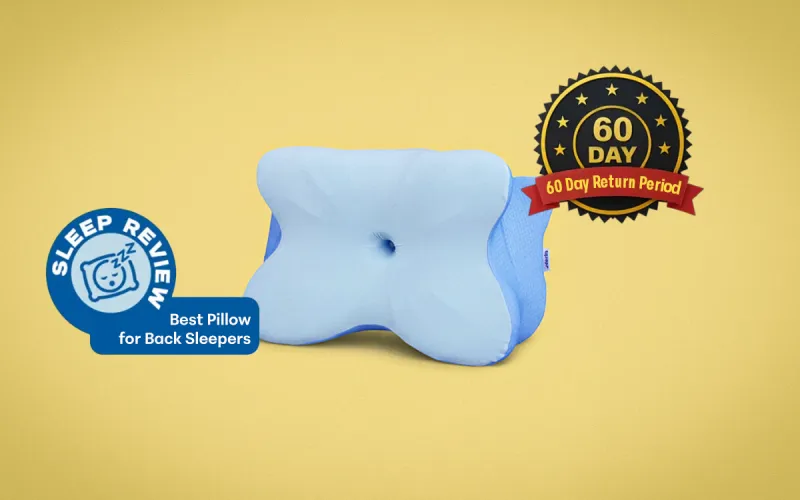
That's when I mentioned Derila Ergo — a contoured pillow I'd started recommending to patients, which I describe not as a pillow but as "a passive positioning system": four support zones built to hold the head and neck in a neutral line and keep it there, through every shift and roll, until morning.
She ordered one that night.

Derila Ergo. It looks strange on the bed. It makes sense the moment you lie down.
What Happened Over the Next Six Weeks Surprised Even Me
I told Carol what I tell everyone: a pillow is not a miracle. I've been burned by miracles too.
So she did what a librarian does. She kept a log. Every morning before coffee, a number from 1 to 10: how clear is my head right now? She brought it to her follow-up.
Night one was odd, she said. Her head dropped into the centre cradle, her shoulder slid into the arch, and her neck felt light, relaxed.
Week one: She woke up in the same position she fell asleep in. Twice.
Week three: The cloudiness that used to sit on the first hour of her day had thinned. Her log said 6s and 7s where there had been 3s and 4s.
Week six is the one she told me about with her voice shaking.
She and Tom were at the kitchen counter and she was telling him about a book — author, title, the year it came out, the student who'd first recommended it — and he put down the paper and said:
"Honey, is that you?"
His smile was priceless.
"I had to turn around to the sink so he wouldn't see my face," she told me.
What made Derila Ergo different from the pillow graveyard?
Every other pillow had supported her when she lay down. This one was still supporting her at 4 a.m. It wasn't that it felt softer. It was that nothing was standing on the hose anymore.
"It was like someone opened a window in a room that had been stuffy for months."
Derila Ergo's Secret: Four Zones That "Take the Foot Off the Hose"
The breakthrough isn't that it's memory foam. Plenty of pillows are memory foam.
It's that every curve has a mechanical job — and together they do the one thing an ordinary pillow can't: hold a neutral neck position for the entire night, not just the first five minutes.
The Dense Memory-Foam Core — holds its shape instead of flattening by 3 a.m. Which means the neck is still supported during the deep-sleep hours when the Brain Sewer actually flushes — not just when you first lie down.
The Center Cradle — holds the head and follows the natural curve of the neck, so it can't tip forward or fall back. Which means the pathway at the base of the skull stays open. In my view, this is the most important zone of the four.
The Raised Support Wings — catch the head when you roll and limit sideways drift. Which means the hose doesn't just get opened at lights-out; it stays open through every shift.
The Shoulder Arch — lets a side sleeper's shoulder sit down instead of shoving the neck sideways. Which means a straight neck-to-spine line on your side, where most of us spend most of the night.
HERE'S WHAT I DIDN'T EXPECT: Carol's morning-clarity log told the story before either of us was willing to believe it. Two weeks on her old pillow stack, then two weeks on Derila Ergo.
avg 3.9
avg 7.2
14 mornings each. Not a clinical instrument — one patient's notebook. But it's the notebook that convinced me.
The change in her house has been just as real.
"I'm reading again — whole chapters, once. I stopped checking the sticky notes and then I stopped writing them. And Tom has stopped watching me carefully, because there's nothing to watch."
When patients ask me what changed for her, I tell them about Derila Ergo. Then I tell them about the hose.
The Science Behind the Results
As I explain it to patients, Derila Ergo's positioning design works on three fronts at once:
1. Neutral alignment all night. The core, cradle, wings and shoulder arch work together to keep the head level with the spine — side or back — and the dense core keeps it there until morning.
2. Fewer interruptions to the cleaning window. A disturbance doesn't have to fully wake you to fragment your sleep and disturb your brain cleaning process. You can be pulled out of deep sleep dozens of times a night and remember none of it. A neck that's out of position does exactly that.
In fact, Carol had been "sleeping eight hours" and half-awake the whole time without realising it.
3. Cooler, deeper sleep. Heat and humidity measurably cut REM and slow-wave sleep — the exact phase the Brain Sewer depends on. Derila Ergo's breathable, temperature-regulating cover counters the heat that builds up under your head overnight, so the cleaning window isn't cut short by a hot pillow.
Side, back, or someone who changes position six times a night — the shape keeps doing its job regardless of how you move.

Shoulder in the arch, head in the cradle, neck in a straight line with the spine. That's the whole idea.
During sleep the space between brain cells expands by ~60% to let waste drain out. — Xie et al., Science, 2013
Real Results from Real Customers


Keep proper body, neck alignment for the WHOLE night. Wake up with less stiffness and more pep.


The position of my head is much better and I wake up without pain in my neck. I feel much lighter and fresh.


Snoring is much reduced. Feeling more refreshed in the morning.


Great neck and head support, I sleep better, breathe better and my neck feels better in the mornings.

Now, the question my more skeptical patients ask at this point: couldn't any ergonomic pillow do this?
Some do one piece of it. A contoured pillow might centre your head but leave your shoulder to twist your neck. A soft one accommodates the shoulder but collapses by 3 a.m. What I haven't found elsewhere is all four jobs — shape retention, centred cradle, lateral stability, shoulder accommodation — in one piece, so the hose stays open all night, not just at lights-out.
And then there's what Carol had already spent.
A year of brain-training app subscriptions. A cabinet of omega-3 and "memory support" supplements. A mattress that cost more than a used car. Twice-monthly chiropractor visits. A sleep clinic consultation that cost more than all of the above and sent her home with a pamphlet.
Every one of them asked her to do more. Derila Ergo asked her to do nothing. She was already going to sleep on something that night. She just changed what.
Nothing to remember. Nothing to take. Nothing to add to the routine. In my experience, the best routine is the one you don't have to remember to perform.
After I shared Carol's story with them, Derila agreed to extend their biggest discount of the year to my readers — 70% off — but only while their current stock lasts.
Here's the challenge…
Derila Ergo frequently sells out because people come back for a second one.

"You're back." Tom now sleeps on one too.
Tom ordered his after the second week, when Carol stopped moving around at night and he stopped moving to the guest room. The multi-pack brings the per-pillow price down further, which is why the inventory moves so quickly.
The multi-pack lets you:
- Put one on each side of the bed — so neither of you is the one tossing
- Send one to a parent who's started leaving themselves sticky notes
- Keep one for the guest room or for travel, so your neck never spends a night on a hotel pillow
If you're waking up cloudy before the day has even started, don't wait another month to rule out the simplest cause.
Every Derila Ergo comes with a 60-night sleep trial. Sleep on it for two months. If your mornings aren't clearer and your neck isn't easier, send it back for a full refund. The risk sits with them, not you.
What the Research Actually Says About Positioning Pillows
of obstructive sleep apnea is position-dependent — the head and airway position changes how you breathe at night.
Respiratory disturbance index in a 22-patient study of mild-to-moderate sleepers using a side-positioning pillow.
of participants in a 30-patient pilot saw fewer breathing disturbances with a head-positioning pillow.
Snoring events with a contoured memory-foam positioning pillow, in a published trial.
I want to be straight with you, because I'd want a colleague to be straight with me.
These are small studies of positioning pillows as a category. Derila Ergo itself has not been put through a clinical trial, and no pillow treats or prevents any disease. The "kinked hose" is a hypothesis researchers are actively studying — a plausible one, in my clinical experience a persuasive one, but a hypothesis.
What is established: sleep is when your brain clears its waste, that clearance drops when sleep is cut short or broken up, and a neck held in a neutral line sleeps more soundly than one that isn't.
If memory worries persist, see your doctor. Carol did. But rule out the thing under your head first — it's the cheapest test you'll ever run, and you were going to sleep on something tonight anyway.
UPDATE
Due to the overwhelming response to this article, Derila has extended their 70% discount for my readers — but only while the current production run lasts.
This pricing is NOT available through retail stores or marketplace sellers. Beware of look-alike "butterfly" pillows sold under other names — they do not carry the 60-night trial. Order only from the official Derila Ergo site below.
References
- Xie L, et al. Sleep drives metabolite clearance from the adult brain. Science. 2013;342(6156):373–377. PubMed
- Shokri-Kojori E, et al. β-Amyloid accumulation in the human brain after one night of sleep deprivation. PNAS. 2018;115(17):4483–4488. PubMed
- Bubu OM, et al. Sleep, cognitive impairment, and Alzheimer's disease: a systematic review and meta-analysis. Sleep. 2017;40(1). PubMed
The characters, quotes, expert voice, stories and testimonials in this article are illustrative and may be dramatized or composited to convey the concepts discussed. Individual results vary and are not typical or guaranteed. The research cited supports the general role of sleep in brain health; it does not establish that any pillow clears waste from the brain, prevents cognitive decline or treats any condition.
This is an advertisement and not an actual news article, blog, or consumer protection update.
MARKETING DISCLOSURE: This website is a marketplace. As such you should know that the owner has a monetary connection to the product and services advertised on the site. The owner receives payment whenever a qualified lead is referred but that is the extent of it.
ADVERTISING DISCLOSURE: This website and the products & services referred to on the site are advertising marketplaces. This website is an advertisement and not a news publication. Any photographs of persons used on this site are models. The owner of this site and of the products and services referred to on this site only provides a service where consumers can obtain and compare.
The offer is not intended to diagnose, treat, cure, or prevent any disease. The offer does not constitute medical advice. The offer is not a substitute for medication or other treatment prescribed by a physician or health care provider. Users should consult a doctor before starting any treatment.


Been using this for 2 weeks now. The shape looked weird at first but I'm waking up in the same position I fell asleep in, which has literally never happened 👍
The hose thing got me. 61 and I've been doing the crossword every day like it's a job. Figured I'd try since there's a 60 night trial. Fresher in the mornings after about a week, no pills.
Took a few nights to get used to but now I can't sleep without it. My husband says I've stopped snoring and I've stopped needing the second coffee.
Bought one for my mom (72) after reading this. She called me on day 9 to tell me she'd slept through the night for the first time in years. Ordering a second for Dad.
WAKE UP WITH MORE PEP. THAT'S IT THAT'S THE REVIEW
Honest review: not a miracle, but I haven't woken up with the rusty-hinge neck in three weeks and my mornings are noticeably less foggy. For a pillow, that's a lot.